Metal Processing International Earns Texas Award
7. May 2012
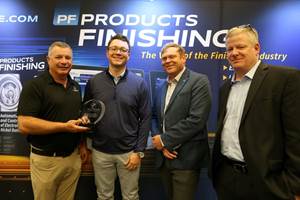
Metal Processing International in Mission, Texas received the Texas Manufacturing Star Award from the Texas Workforce Commission at a business conference May 4.
[ Log On ]

Metal Processing International in Mission, Texas received the Texas Manufacturing Star Award from the Texas Workforce Commission at a business conference May 4.


Q. Our company produces oven racks. The base material is a low-carbon steel (SAE 1006/SAE 1008). The racks are nickel-chromium plated, and the process we use for the plating is as follows:
After the process is completed, the plating has the feel and look of sandpaper, and we must have a bright, smooth finish. Can you give me any suggestions for solving this problem? F.A.
A. I agree that a sandpaper-type finish might have applications in certain areas, but not in decorative plating. Based on the information you provided, I can’t give you a definitive answer to your problem, but I certainly can give you some guidelines for troubleshooting.
The first thing I would do is inspect the parts after each step of the process. Are they smooth and not pitted after the degreasing and acid pickling steps? If yes, then these steps are not at fault. Do the same after each of the plating steps and, if you find the parts have roughness, for example, after the semi-bright nickel plating step, then that step should be investigated in more detail. If the roughness appears after your decorative chromium step, then the chromium plating bath must be investigated.
Assuming that by using this approach you can pin down the step that is giving you the roughness, you will now have to determine what the cause is. In most plating baths, roughness is usually caused by suspended materials in the bath. There are a number of possible causes for this. Start by looking at your filtration system. Filter cartridges do not last forever and must be changed on a regular basis. The cartridge you are using may not filter out the smaller particles that show up in plating baths.
If the baths are only used for short periods of time, they should be covered to keep out dust and grit that can fall into the tanks from the environment. Sometimes particulate matter is due to defective anode bags. The anodes should always be bagged and the bags inspected on a regular basis for tears. Another cause of particulate matter in the plating bath can be parts that have dropped into the tank or fallen off the rack during the plating process. If the drops are not removed promptly they may start dissolving, causing a rough deposit.
Other possible causes of rough deposits in your nickel baths are:
If you determine that the roughness appears after the chromium plating steps, there are a couple of possible causes: Your current may be too high or suspended particulate matter may be present.
.jpg)
Q. Are color changes for powder that are under one minute really possible? I spray all manual in one booth, but I have automatic guns in the other one, and we do reclaim some of our colors, but not all of them. M.G.
A. A single powder gun can be color changed by one person in less than one minute. It requires the right equipment to be able to quickly purge the gun interior and switch over to the new color, but it is possible. You can use a box feed system and clean the gun up, change the box and then start the new color. Or, you can use a manifold with a switch system and a series of dedicated feed hoppers for even-faster color change times.
Keep in mind that the actual color change time is partly dependent on how close the parts are racked. You may be able to physically change the gun over, but you cannot discharge a color too close to a part that is not supposed to be that color. If you are cleaning the gun and next part is only a couple of feet away, you will get some of the powder on that fresh part. Or if a coated part is still leaving the booth, you could get some of the new color on the trailing edge. Realistically, you can change the gun in around 20 or 30 sec, but the spacing is most likely going to be greater due to the risk of cross contamination.
Now, if you have the clean the booth walls, or if you have automatic guns, or if you intend to recover the colors for reuse, the game changes. Automatic guns can be purged automatically using a manifold system and a color-feed center. Booth walls can be cleaned more quickly if the booth construction is designed for fast color change. In a best-case scenario, you can go from reclaim color to reclaim color in 10 to 15 minutes with automatic guns. You can go much faster if you do not reclaim. These booths use cyclone recovery systems to avoid the time involved in moving collectors for reclaim colors. The cyclone itself does not necessarily speed up color change time unless it is fitted with the right features.
It all depends on what you need in terms of reclaim and what equipment you buy. You can get some very fast times if you invest in the right equipment.