Air Force Modifies Clemco Paint Stripping Equipment With Robotic Technology
The new paint removal process uses robots to increase efficiency of stripping paint off fighter aircraft.


For more than three decades, Hill Air Force Base in Utah has stripped paint off fighter aircraft using Clemco abrasive-blasting equipment. Last year, the base’s 576th Aircraft Maintenance Squadron modified an existing Clemco blasting facility with new-generation robotic technology. The facility now strips paint off the A-10 Thunderbolt II (nicknamed the Warthog).

Clemco blasting equipment at Hill Air Force Base prepares to strip paint off a first-production A-10 aircraft. (U.S. Air Force photo by Todd Cromar)
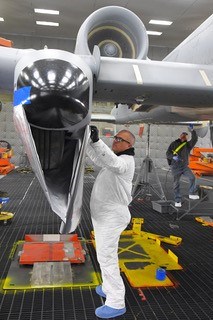
Corrosion-control technicians seal up the seams and holes in a first-production A-10’s outer surface skin to prevent blast media from entering the aircraft. (U.S. Air Force photo by Todd Cromar)
The new paint removal process is accomplished by two robots, each with four hose attachments that move independently along both sides of the aircraft. The time to strip an A-10 has decreased from three days to 9-12 hours. The A-10s require regular exterior maintenance to protect their metal surfaces from corrosion due to moisture and the harsh environments in which they continually operate.
“There are going to be across-the-board improvements, including a dramatic reduction in exposure to a hexavalent-chromium dust environment. This is perhaps the greatest benefit to the robotic system,” said Tim Randolph, director for the 576th Aircraft Maintenance Squadron. “Savings will also be seen with reduced operating time and less power consumption, as well as reduced costs in material. We really haven’t found a downside to this system.”
Clemco manufactures air-powered abrasive blast equipment used to clean, deburr, shot peen, remove coatings, finish or otherwise improve surfaces being blasted.
Related Content
-
CONTRAX Grand Rapids 2026 Registration is Now Open
Following its successful Austin, TX debut, CONTRAX invites contract manufacturing parts, components and services buyers from across the industrial supply chain to register.
-
How Cryogenic Deflashing Improves Injection Molded and Die-Cast Parts Finishing
Cryogenic deflashing is a quick, repeatable and cost-effective method for removing a common molding defect known as flashing from part surfaces.
-
Engineering With Impact: Shot Peening’s Expanding Role in Aerospace
From landing gear to next-generation aircraft components, this advanced surface treatment safeguards against extreme conditions and pushes aerospace materials to new limits.


